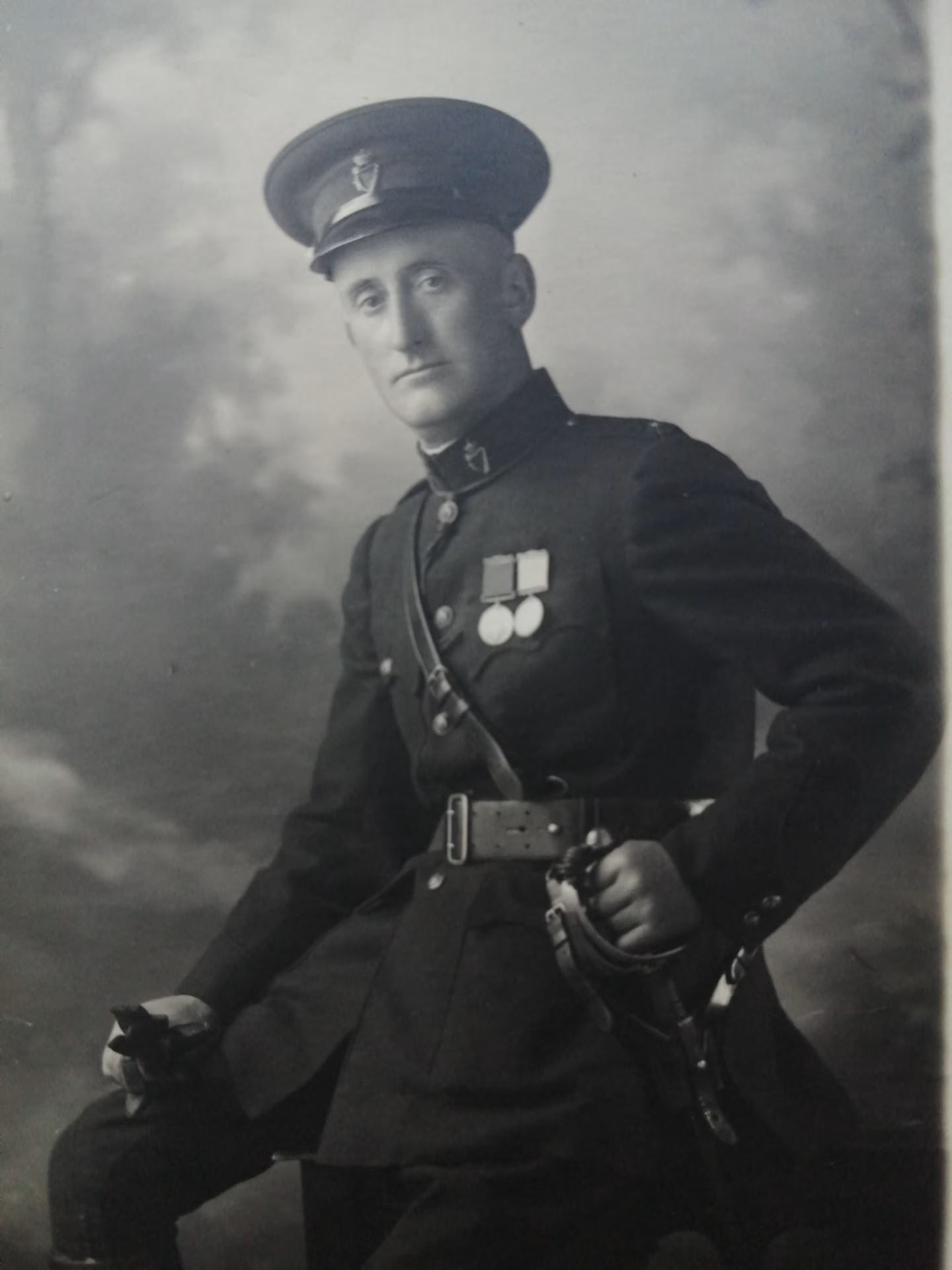
William Lynn, who died in Armagh in 1963, was one of the most brilliant Irish police officers of his generation. His intellect and ability marked him out during a career that spanned nearly five decades, across seismic events such as two world wars, the Irish revolution and the partition of Ireland. Lynn was born in 1879 on a farm near the Antrim glens. His parents, John and Martha, owned a small farm; both were illiterate. The Lynns were Catholics. At the age of 20, William Lynn joined the Royal Irish Constabulary. One of his first duties as a policeman was to provide a guard of honour for Queen Victoria’s visit to Dublin. He was then posted to Glenveigh in County Donegal, and later Doaghbeg in the same county until 1902.
After a six-year period as a constable in Belfast, Lynn was sent to Westmeath in 1908 where he was promoted to sergeant. It was here that Lynn’s remarkable intelligence and investigative qualities first made a public mark. In 1913, while serving as the police inspector of weights and measures, Lynn successfully prosecuted the Earl of Longford for “having an unjust weighbridge in his possession” at Killucan. A year later, as a sergeant in the Westmeath village of Kilbeggan, Lynn doggedly investigated the murder of John Crowley, arresting a principal suspect, Joseph Connell, who he believed had fatally shot Crowley during a period of pronounced agrarian violence in the area. Lynn had a key witness – Jane Cobbe, a local landowner who employed the principal suspect, Joseph Connell. Days after Connell’s arrest, Mrs Cobbe was found drowned in the Silver River which ran alongside her house.
Although the case against Connell collapsed, Lynn’s capacity for methodical police work had won him the admiration of an important patron. In 1914 his superior, the district inspector for Moate, William Atteridge, was transferred to take command of ‘B’ district in Belfast, a largely Catholic area centred on the Falls Road in the west of the city. In an organisation with a markedly Anglo-Irish, and somewhat patrician, hue to its elevated ranks, Atteridge was another Catholic officer from modest means who had risen through graft and intelligence. He did not forget Lynn, who in 1918 was appointed as a head constable in west Belfast, based at Henry Street and Cullingtree Road barracks.
Policing Belfast was one of the RIC’s most difficult tasks. Loyalists in the city resented and suspected the largely Catholic (and southern) constables who patrolled the city’s streets. Nationalists in the city, including the west Belfast MP Joe Devlin, also had mixed relations with the force – sometimes looking to it for protection, such as during the 1886 riots, but also saw the RIC as decidedly partial in its approach towards militant Ulster unionism, having failed to suppress the threat posed by the Ulster Volunteer Force to home rule in 1913 and 1914.
Belfast in 1918 was a largely “Devlinite” city, a redoubt of the Ancient Order of Hibernians and the Irish Parliamentary Party that resisted the Sinn Féin republican tide that saw Sinn Féin candidates win a large majority of the Irish seats at Westminster during the general election of that year. There were frequent violent attacks between Hibernians and Sinn Féin supporters in the city – a rally by Sinn Féin leader Éamon de Valera, who ultimately failed to take Joe Devlin’s seat later that year, was disrupted by Devlin’s supporters who raised “three cheers for Captain [William] Redmond”. The assembled Sinn Féin leaders and their supporters were very much in the minority; attempts were made by Devlin supporters to storm the platform. A number of policemen were injured before de Valera could be escorted away from the Falls Road – among them was Sergeant Christy Clarke who was shot dead two years later by the Irish Republican Army. Then Head Constable Lynn later recalled that, such was the mood in the Falls Road that night, the police had certainly saved de Valera from serious violence.
In 1920, Lynn came first in the exam for promotion to the rank of district inspector, an ‘officer’ position in the RIC. Shortly afterwards, he was sent to take command of the district of Newcastle West in County Limerick. At the end of 1920 martial law was declared in Munster – and Lynn enforced it. He appears to have been unsympathetic to claims for compensation for damage caused by ‘official reprisals’ by the military during this period. On 1 September 1921, Lynn was given command of ‘D’ district in north Belfast, possibly at the recommendation of DI Atteridge who now occupied a staff role in Belfast city police headquarters.
Lynn’s appointment came in the midst of what nationalists would later call the ‘Belfast pogrom’. A series of IRA killings of prominent Ulster policemen in the summer of 1920 and an inflammatory speech given by unionist leader Sir Edward Carson to the city’s Orange lodges in July 1920 had unleashed a wave of workplace expulsions and attacks on Catholic areas of the city, including the burning of houses and murder of civilians. From July 1920 to September 1922 just under 500 people lost their lives. Close to 8,000 people were forced out of their homes. Catholics businesses, especially public houses were also targeted; many were burned and / or looted. The majority of the killings occurred during the first six months of 1922. Most of the dead – perhaps as high as 80 per cent – were civilians who were not members of the police, military or any paramilitary organisation. Although Protestants made up a minority of those killed, just under 200 killed in a city with a two-thirds Protestant majority population, the majority of Protestant victims were also civilians. Most killings occurred during the first six months of 1922, shortly after DI Lynn returned to the city – and his district, along with that of DI John Nixon’s ‘C’ District in west Belfast, was very much at the centre of this sectarian inferno.
John Nixon, the son of Methodist farming stock from County Cavan, was another policeman ‘risen from the ranks’. And, like Lynn, he was accustomed to being sent to ‘distressed’ policing districts or trouble spots. Unlike Lynn, Nixon had given up any pretence of professionalism; he supported, and protected, some of Belfast’s most violent loyalists. As well as serving in Strokestown in Country Roscommon, Nixon had also been the district inspector for Lisnaskea district in south-east Fermanagh. When the Fermanagh IRA attacked Tempo RIC barracks, killing Sergeant William Lucas, they left a note warning Nixon and his men not to carry out any reparations. Nixon reacted furiously, telling the inquest into his sergeant’s death, “I am the District Inspector, and I care no more about Irish Republican Army than I do about a dog in the street.” He then struck the table, shouting, “Never! Never!” He directly blamed Monaghan IRA commander Eoin O’Duffy for the violence and threats made against him and his men.
DI Lynn had the misfortune to take command at the same time as Eoin O’Duffy arrived in Belfast as Sinn Féin’s liaison officer with the city authorities – a truce having been agreed in July 1921 between the republican leadership and the government, a prelude to negotiations that culminated in the Anglo-Irish Treaty five months later. Eoin O’Duffy and Nixon now renewed attempts to kill each other. Rather than asking for calm, O’Duffy told the northern IRA that, whatever happened in London, they were still “at war” with the new Northern Irish government that had been established in May of that year, and to accelerate arson attacks against unionist owned businesses and assassinations of policemen in the city. Meanwhile, the British Army and the government in London concluded that Nixon was running his own loyalist “murder gang”, responsible for a number of atrocities in ‘C’ District.
Lynn’s predecessor, DI J.J. McConnell had been sympathetic to Sinn Féin; by McConnell’s account he was shot and wounded by a ‘B’ Special in July 1921. Policing in Belfast was falling apart due to the pressure of inter-communal violence and political factionalism. The British administration in Dublin Castle, in a misguided attempt to suppress loyalist paramilitarism and ease British Army manpower shortages, permitted the formation of the Ulster Special Constabulary. Units of the UVF, plus their former commanders, had essentially been turned into part-time police, the ‘B’ Class of the USC. The full-time ‘A’ Specials were more disciplined, but the British Army reported that ‘B’s were responsible for much of the burning and the killing – rather than deterring violence, they were an accelerant. In September 1921, the British Army in Belfast ordered the ‘B’ Specials off the streets of Belfast.
Infuriated, loyalists created their own paramilitary organisation, the Ulster Imperial Guards. Unlike the more socially elite commanders of the UVF, the dynamic leadership of the Imps came from working class trade unionists and non-commissioned officers who had returned from the First World War. Nearly 8,000 strong in Belfast alone, they warned Northern Ireland’s prime minister against any compromise with Dublin; they also demanded more jobs for “loyal men” and better housing – if Sir James Craig did not give them what they wanted, an Imps’ leader warned, they reserved the right to use their “three yards of steel” [rifles] against “Sir James Craig and his £3000 a year cabinet”.
Alarmed by threats from this loyalist force, Craig persuaded British prime minister David Lloyd George to cede control of security primacy for Northern Ireland to his government. This was later confirmed under the Civil Authorities (Special Powers) Act (Northern Ireland). Meanwhile, Craig negotiated with the Imperial Guards through the Orange Order, agreeing to co-opt many of its ranks into a new, better-paid and well-armed class of the constabulary, the ‘C1’ Class, sometimes referred to as ‘Ulster’s Army’.
The advent of the Imps, and the reappearance of the ‘B’ Specials, in November 1921 saw a catastrophic escalation of violence in Belfast. Negotiations with Sinn Féin and the subsequent Anglo-Irish Treaty profoundly alarmed loyalists who believed that an Irish state, with its own Irish National Army armed by the British War Office, would ultimately invade Northern Ireland. North Belfast – D District – experienced a wave of atrocities, including the infamous Weaver Street massacre, when a bomb was thrown into a small, Catholic enclave, resulting in the agonising deaths of four children and two women.
DI Lynn’s response to this violence was to do what he always did – observe carefully and gather evidence. During the autumn of 1921 he successively arrested and charged some of the most active Imperial Guards gunmen in his district. But this was not Limerick; Belfast was not under martial law. Instead, Belfast juries persistently acquitted alleged loyalist out of political sympathy towards the accused or fear of reprisal. Lynn and his men soon found that key police witnesses such as publican Patrick Connolly, who testified against six notorious Imps in north Belfast, and 15-year-old Patrick McGurnaghan, who was a witness in the trial of a loyalist accused of shooting a female Catholic shopkeeper in the face, were shot by loyalists as a result – Connolly died; McGurnaghan survived but refused to testify in the forthcoming trial.
In late February 1922, DI Lynn prosecuted David Duncan, who had previously served in the British Army, as well as in the RIC Auxiliary Division. Duncan, now a commander of the Imps in north Belfast, was accused of the murder of a shopkeeper, James McIvor, on 25 November 1921, and the attempted murder of publican Patrick McMahon the day previously. A number of witnesses to the shooting refused to testify against Duncan. However, Patrick McMahon agreed to do so – McMahon came from a prosperous family of Belfast publicans; his brother Owen McMahon was a prominent member of the board of management of the Ulster Vintners’ Association. A key witness to the McIvor shooting, Bernard Monaghan, had soldiered with Duncan in Salonika during the First World War. He confessed to being nervous about coming forward, worried that his former officer would ‘give him one too’. Monaghan was right to be worried; Duncan was acquitted of all charges. A particular affront to William Lynn was that a sergeant under his command, William Robb, gave evidence of Duncan’s “good character” for the defence. Bernard Monaghan quickly fled Belfast, joining the National Army; Patrick McMahon also left the city for a time.
In September 1922, David Duncan attacked a police sergeant shortly after his application to join the RUC was turned down. Far from being a model soldier, he had been dismissed from the British Army towards the end of the war due to his erratic behaviour, largely induced by his alcoholism. His contract of service with the Auxiliary Division has also been terminated due to poor discipline shortly before his move back to his native Belfast in October 1921. Duncan later emigrated to Canada where he was confined to a mental hospital in Toronto after he attacked a police officer with axe. His psychiatrists concluded that he was an incurable paranoid schizophrenic. By his own account, Duncan had been hearing voices for many years. His wife claimed that Duncan confessed to her that he murdered James McIvor.
A few weeks after his trial for murder and attempted murder, David Duncan joined the ‘C1’ Class of the USC, which at that time operated in civilian clothes with an armband for identification. Days later, in the early hours of 24 March, a group of four uniformed special constables led by a man dressed in civilian clothes (and who matched Duncan’s description) smashed their way into 3 Kinnaird Terrace where they shot dead Owen McMahon, his four sons and an employee of the family, Eddie McKinney. (Two of Owen’s sons survived – Michael, who hid under a table, and John who was seriously wounded but made a partial recovery). DI Lynn led the investigation, focusing on Special Constabulary barracks in the vicinity of the York and Antrim Roads. A few days later, Lynn was called into investigate a police atrocity in Nixon’s district – the Arnon Street killings of six catholic residents on the night of 31 March / 1 April. Lynn was working closely with the military, who demanded that suspected police murderers take part in a police line-up.
Lynn and the military were being stonewalled. Nixon and the Special Constabulary refused to cooperate with the investigation. The intelligence officer of First Battalion, Norfolk Regiment of the British Army in Belfast urged their superiors to face down Nixon and purge the police of the murderers within its ranks. No such action was taken, at least in the short-term. Owen McMahon’s widow, Eliza, lost faith in the police and did not want to cooperate with Lynn, possibly out of fear of more reprisals. DI Lynn, having repeatedly failed to convict loyalists charged with murder, appears to have abruptly ceased his investigations into the McMahon and Arnon Street murders.
After its failed “northern offensive”, IRA operations in Belfast were called off in June 1922. By the end of 1922, with the Free State in the midst of a Civil War, the threat to Northern Ireland had subsided. James Craig and his government moved to intern some of the most notorious loyalist killers in the city; most were released after a few months and encouraged, or even paid, to leave Northern Ireland. Lynn went on to serve as a much-admired officer in Strabane, ‘B’ district in Belfast and the city of Londonderry. He was frequently called upon to help investigate the RUC’s most difficult cases.
Lynn’s retirement in 1939 was interrupted by the Second World War; he was recalled to service, and was posted as DI to Armagh in 1940, before returning to Derry in 1942 where he served until the end of the war. In both cities he showed his typical investigative zeal, seizing a large amount of IRA explosives in Derry. His life, however, was marked by considerable personal loss; his wife died following a sudden illness in 1925, and his son Jack was killed while serving as a pilot in the Royal Air Force in 1942. While in Derry, be begged to be allowed to return to Armagh – his request was denied until after the end of the war. Shortly before his retirement from the RUC in 1945, he married for a second time. He and his wife Rose Ann, daughter Rosemary and son Christopher subsequently lived at 21 Victoria Street in Armagh. William Lynn died on 17 October 1963 at the age of 84.
Although not known for his strong political views, Lynn clearly had some affection for the monarchy. As chairman of the Rotary Club in Derry he crafted an effusive motion of a sympathy following the death of George V in 1936. In 1938 he was awarded an MBE during a ceremony at Buckingham Palace. Like William Atteridge, and unlike J.J. McConnell, Lynn stayed on in the police in Northern Ireland, working to professionalise its ranks. Some, including John Nixon (later an independent unionist MP after he was dismissed from the police in 1924), questioned the loyalty of senior Catholic officers in the force. Others, not least republicans, believed that they should not have served a unionist government.
In 1922, DI William Lynn was thwarted in his investigations at a critical moment for the future of Northern Ireland, and, like the officers of the Norfolk Regiment, was outmanoeuvred by those in government in London and Belfast for whom it was more expeditious to look away. Instead of resigning and making public his concerns, he persevered in the force. That decision was a questionable one. But what is not in doubt is that policing in Northern Ireland could only have been improved by the presence of a professional officer like William Lynn.
A version of this article was first published in History Armagh – Vol. 6, No. 1 (January 2026). Dr Edward Burke is an Assistant Professor in the History of War at UCD.
Sources and Further Reading
Edward Burke, Ghosts of a Family: Ireland’s Most Infamous Unsolved Murder, the Outbreak of the Civil War and the Origins of the Modern Troubles (Merrion Press, 2024).
Archives of Ontario [AOO], RG 10-270, Ontario Hospital Patient File, 20977 – David Duncan,
Police Museum of Northern Ireland, District Inspectors’ Records.
Public Record Office of Northern Ireland, MIC150/1, July 1920-September 1936 Journal of District Inspector W. Lynn / HA/5/193, Shooting of Owen McMahon and Family and barman Edward McKinney (seven in all) at 3 Kinnaird Gardens, Belfast: Witness Statements.
Royal Norfolk Regiment Museum, Norwich, Intelligence Reports, Belfast, 1921–1922.

Leave A Comment