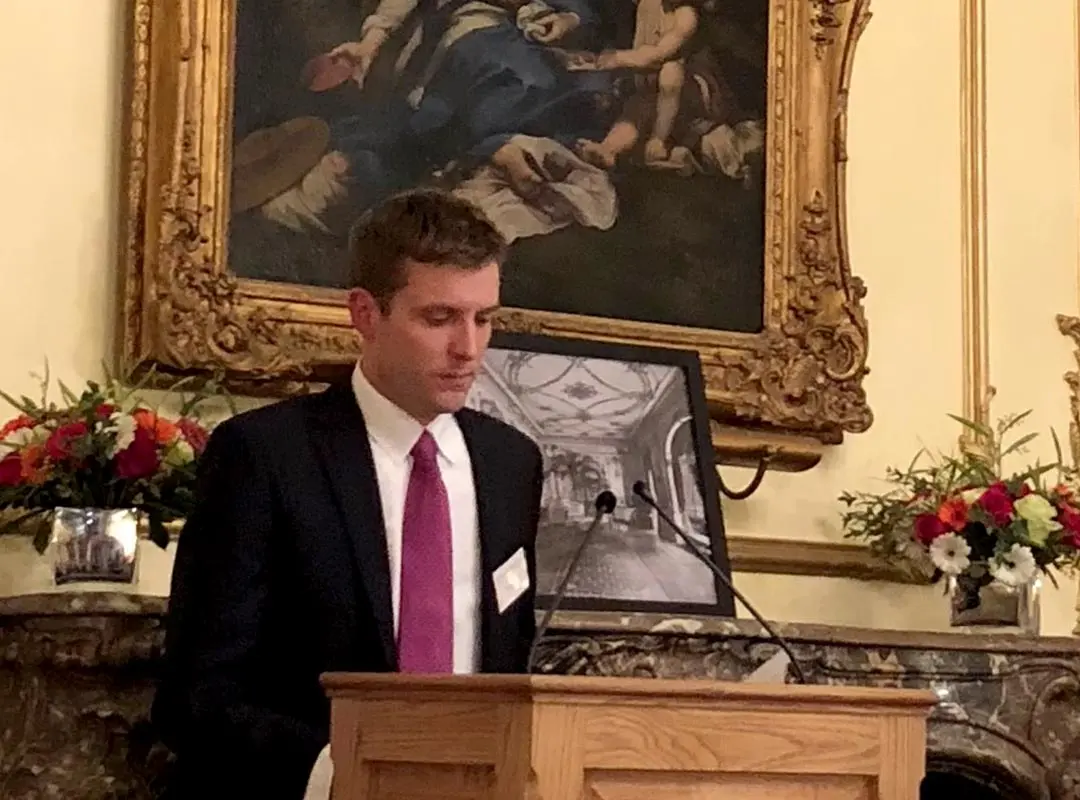
Speech at the Thomas Francis Meagher 178th Anniversary Tricolour Festival
7 March 2026
Dr Edward Burke
UCD
Thomas Francis Meagher is seen as the very epitome of an Irish patriot, but he was also deeply committed to the idea of a community of European nations. He read obsessively about the liberation of Greece – not least about the volunteers, like Byron, who came to its aid.
He was also, strikingly for a man descended from Jacobites, interested in the Dutch republics and their resistance against French autocracy in the 17th century. He tried to use this example to make his case in Ulster, without much success.
Meagher’s constant theme is to stick to principles, not to sell them for narrow and corrupting aggrandisement. The Irish people, he warned, were in danger of being lured by material gain to give up their right to nationhood: “From the story of Sparta learn nothing but the obedience of the Helots. From the pictured page of Livy learn, if you like, the ambition of the Cesars, but shun the stern incorruptibility of the Gracchi. Thus will you climb to power, gain access to the Viceregal table, and be invited to the masquerades at Windsor.”
Give up your rights and the principles of humanity and “you will experience the munificence of empire.” In a speech in 1846 in which he quoted Byron’s Childe Harold’s Pilgrimage, he condemned those “who deny to Ireland what they assert for Poland … ‘Plod on in sluggish misery rotting from sire to son, from age to age, Proud of their trampled nature’”
Meagher was no pacificist when it came to freedom of European nations: “Abhor the sword? Stigmatise the sword? No, my lord, for it swept the Dutch marauders out of the fine towns of Belgium – swept them back to their phlegmatic swamps, and knocked their flag and sceptre, their laws and bayonets, into the sluggish waters of the Scheldt … I learned it was the right of a nation to govern itself – not in this Hall, but upon the ramparts of Antwerp … I honour the Belgians, I admire the Belgians for their enthusiasm, their courage, their success, and I, for one, will not stigmatise, for I do not abhor, the means by which they obtained a Citizen King, a Chamber of Deputies.”
Meagher also admired the liberty attained by Switzerland. In a speech in 1847 he invited his audience to picture an arcadian vision of national liberation:
“By the soft, blue waters of Lake Lucerne stands the chapel of William Tell. On the anniversary of his revolt and victory, across these waters, as they glitter in the July sun, skim the light boats of the allied cantons. From the prows hang the banners of the republic, and as they near the sacred spot, the daughters of Lucerne chant the hymns of their old, poetic land.”
America too was a guiding light. At a speech at a banquet given to honour officers of American famine relief ships, Meagher observed that “a nation achieving its liberty acquires the power that enables it to be a benefactor to the distressed communities of the earth.”
For Meagher, to be a benefactor to the distressed, the poor, the starving in the world, was not an occasional or optional charitable activity. It was the very essence of being a republic.
The proof of a republic was in its humanity to others.
Today these are values that are ebbing in much of the world. It has therefore never been more important that we cleave to them more firmly in Meagher’s native country.
We could use some of his clarity and eloquence today.
If we in Ireland value our civil liberties, the freedoms and democracy that we have built at home and through the EU we need to think about how we can defend these in an increasingly anarchic world.
It is worth recalling Meagher’s hopes for Europe, and especially for France – how inspired he was by the principles of the uprisings of 1848, the potential for solidarity in Europe. In a speech in Dublin on 11 March of that year, Meagher imagined that despotism – that might is right among nations – would be a thing of the past, “Has not France proclaimed herself the protectress of weak, and is not the sword of the Republic pledged to the oppressed nationalities which, in Europe, and elsewhere, desire to reconstruct themselves? … But do not wait for France.”
Let us stay with a French republic, but move to 2026, and President Emmanuel Macron’s speech at the weekend in which he spoke about existential threats to the Europe.
Europeans know that President Putin, already attempting to annex and colonise one European country, may invade another in the near future. But we also know that that there are those in Washington and Beijing who wish to dismantle the EU and destroy the power of its institutions, not least the European Commission when it comes to trade.
Last year the US national security strategy claimed that the institutions of the EU were designed to “undermine political liberty”. The Trump Administration and its allies in the tech sector / Silicon Valley, not least Elon Musk, are increasingly supporting far-right parties in Europe who also wish to destroy the power of European Union and the writ of European democratic institutions.
We know about Russia and China’s many crimes. But now the United States Secretary of War also says that the US recognises no “rules of engagement” in Iran. Trump cares little for international law; he ignores it, he violates it. Treaties which Ireland holds dear, related to arms control, are frayed, if not rapidly being ripped asunder.
Macron spoke last weekend with the clarity of Meagher:
“The weight of the last six years is that of decades for France and Europe. And the last few months have had the weight of years. Our competitors have evolved, as have our partners. The world has become a tougher place, as the last hours have shown once again. It is therefore with the greatest solemnity that I have come today to announce before the nation an evolution equal to the challenges faced by France and Europe.”
He then warned Europe of a shattered international landscape:
“Today, international agreements on arms control are at a loss. Let’s look at the situation with clear eyes. Everyone has taken their liberties. The United States put an end to the anti-ballistic missiles treaties. The United States and Russia put an end to the intermediate-range nuclear force treaties, the provisions of which Russia had long violated. The New START Treaty, which governed US and Russian nuclear arsenals, ceased to exist a few weeks ago. Russia deratified the Comprehensive Nuclear Test-Ban Treaty, which the United States, meanwhile, had never ratified. A resumption of tests would end an almost 30-year-long moratorium. China, meanwhile, is catching up, and is not taking part in anything. So let’s be honest: The field of rules has turned into a field of ruins.”
President Macron also outlined Europe’s dilemma and its potential response.
“Europeans have become used to their security depending on rules made by others, in other times, and rescinded also, sometimes, unbeknownst to them , often at their expense. Let us be clear, the European security architecture was just that: agreements dating to the Cold War negotiated by others, including when they concerned us, and they were terminated by the very same States that had signed them, with no consultation, even when they were our allies. This era calls for another method. We must rebuild a body of rules – as far as we are concerned, one rooted in our security interests and those of our continent.”
Meagher’s principles were clear. Sometimes empires need to be opposed, to meet resistance.
This is why Ireland, which has done so much for Ukrainian refugees, must do more to support Ukrainian resistance.
As Joe Hackett, Ireland’s most senior diplomat, recently observed – the government’s financial contributions to Ukraine have been “well below” the amount of support provided by most other EU states, including countries with smaller economies than Ireland.
Almost nobody at home or in the wider European continent wants Ireland to join NATO.
But we should do more for homeland defence. European democracies expect Ireland to safeguard its seas and its air space against hostile threats.
In recent years we have had endless debates in the Oireachtas about the triple lock – an important issue – but very few about how to bolster the state’s defence capabilities.
The 2020 Department of Defence equipment development plan noted that Ground Based Air Defence and Counter Unmanned Aerial Systems procurement should be urgently acquired as a priority. It also recommended that new equipment needed to be acquired to detect threats to subsea infrastructure.
Procurement of these vital capabilities was delayed for years. Not having them in place for the EU presidency is distinctly problematic, not least due to an escalation of Russian sabotage and espionage in Europe and incursions into Ireland’s air space and marine territory.
The reported drone threat to Ukraine’s President Zelensky during his recent visit to Ireland highlighted not only a gap in capabilities but also a national security architecture that could plan, deter and respond to such incidents.
The European Commission has also warned Ireland about industrial espionage – hostile states stealing intellectual property. Sometimes it is not even that difficult. Academics based at Irish universities have taken part in projects to support China’s space programme. The Chinese space programme is largely controlled by the People’s Liberation Army.
We need greater resources to defend ourselves against 21st century threats but, above all, we need much greater political priority and leadership on these issues.
There are some belated signs that Ireland is changing course and beginning to address these threats. The recent maritime security strategy – advocates much deeper partnerships with European democracies, including cooperation with the non-NATO Joint Expeditionary Force that aims to protect European subsea infrastructure.
Ireland has also increased its aid spending, although we need to spend much more if the institutions we value – such as the UN – are going to weather the current anarchy.
We also need to consider how we regulate multinationals – such as X or Meta – platforms that increasingly spread disinformation, including from X’s owner, that sow extremism and attack European democracies with disinformation.
Meagher said that he would not yield the principle of European liberty for the “munificence of empire”. We should never tolerate or indulge agents of Europe’s demise.
About Edward